
Modern cars are no longer just mechanical machines. Every new vehicle on the road today is a moving network of computers, sensors, and control units. At the heart of this system lies the engine control unit, often supported by several other ECUs working together. Understanding how these ECUs communicate is essential for accurate vehicle diagnosis—and this is exactly where professional diagnostic tools make the difference.
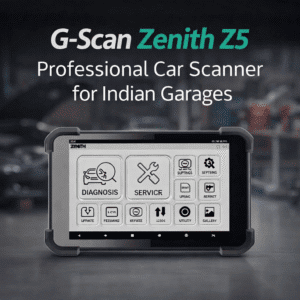
Many technicians can read error codes, but very few truly understand what is happening behind the scenes. This blog focuses on auto ECU communication, how data flows inside a car, and why advanced diagnostic systems like G-Scan Zenith Z5 can interpret this information more accurately than basic scanners.
Understanding the Role of ECUs in Modern Vehicles
An ECU for car is not a single unit anymore. Today’s vehicles contain multiple electronic control units, each responsible for a specific function. The most critical among them is the engine electronic control unit, which manages fuel injection, ignition timing, emissions, and engine performance.
Alongside it, you will find units such as the transmission control unit, which controls gear shifting logic, and other engine control modules dedicated to emissions, throttle control, or hybrid systems. These ECUs constantly exchange information to ensure the vehicle runs smoothly under different driving conditions.
If communication between these units is disturbed, even slightly, the vehicle may show warning lights, reduced performance, or unpredictable behavior.
How ECU Communication Actually Works
Every ECU sends and receives data through vehicle communication networks. These networks allow ECUs to “talk” to each other using structured signals rather than simple on/off commands. When a driver presses the accelerator, the pedal sensor does not directly increase fuel flow. Instead, it sends data to the engine control unit, which calculates the correct response and coordinates with other modules.
This communication includes:
Sensor values
Command signals
Feedback responses
Status confirmations
A professional diagnostic system must understand not only the data but also the communication logic behind it. Without this understanding, diagnostics remain incomplete.
ECU-Controlled Safety Systems and Their Communication Needs
Modern safety systems depend heavily on ECU communication. Systems like electronic stability control, electronic stability programme, and vehicle stability control rely on real-time data exchange between multiple ECUs.
For example, when wheel slip is detected:
Wheel speed data is sent instantly
Engine power may be reduced
Brake pressure is adjusted
Transmission behavior is modified
All this happens in milliseconds. A weak diagnostic tool may only show a fault code, while a professional scanner can access the deeper communication layers that explain why the system reacted in a certain way.
Why Generic Diagnostic Tools Fall Short
Many garages rely on basic scanners for engine diagnostic tasks. These tools often read generic fault codes and display limited information. However, modern vehicles demand more than basic code reading.
Generic tools struggle because:
They cannot fully communicate with all ECUs
They miss manufacturer-specific data
They fail to interpret live communication between modules
This results in trial-and-error repairs, wasted parts, and unhappy customers. A true tool diagnostic approach requires understanding ECU communication, not just reading error messages.
The Importance of Accurate Diagnostic Software
Behind every professional scanner lies powerful diagnostic software. Software determines how accurately the tool can communicate with ECUs, retrieve data, and present it in a usable format.
Advanced software allows technicians to:
Access multiple engine control modules
Read real-time data from the engine control unit
Analyze interaction between engine and transmission control unit
Identify communication mismatches rather than just faults
This is where professional tools stand apart from entry-level devices.
Why G-Scan Zenith Z5 Excels in ECU Communication
The strength of G-Scan Zenith Z5 lies in its deep understanding of vehicle communication architecture. Instead of treating ECUs as isolated units, it approaches diagnostics as a connected system.
Zenith Z5 communicates accurately with:
Engine electronic control unit
Transmission control unit
Safety and stability control systems
Manufacturer-specific engine control modules
This allows technicians to see the full picture rather than isolated symptoms. Communication accuracy ensures that diagnosis is based on actual vehicle behavior, not assumptions.
From Data Reading to Meaningful Diagnosis
Reading ECU data is one thing. Understanding it is another. A professional diagnostic system must filter raw data and convert it into actionable insights.
For example:
A sensor value may look normal individually
But when compared with other ECUs, it may reveal timing mismatches
Only accurate ECU communication exposes such issues
This level of clarity improves repair accuracy and reduces comeback cases in workshops.
How ECU Communication Impacts Repair Quality
Incorrect ECU communication diagnosis often leads to unnecessary part replacement. A technician may replace a sensor, when the real issue lies in data interpretation or signal delay between ECUs.
By using a reliable diagnostic tool, workshops can:
Identify communication faults early
Avoid replacing good components
Improve customer trust
Save time and labor costs
Modern vehicle repair is no longer about speed; it is about precision.
The Future of Automotive Diagnostics
As vehicles become more software-driven, ECU communication complexity will continue to increase. Hybrid systems, ADAS features, and connected vehicles rely even more on seamless data exchange.
In this environment:
Advanced diagnostic software becomes essential
Professional tools replace basic scanners
Understanding auto ECU logic becomes a core technician skill
Workshops that adapt early will stay competitive in the evolving automotive service industry.
Conclusion
Modern vehicles rely on complex communication between multiple ECUs, from the engine control unit to the transmission control unit and safety systems like electronic stability control. Accurate diagnosis today depends on understanding this communication, not just reading fault codes.
Professional diagnostic systems like G-Scan Zenith Z5 bridge the gap between raw ECU data and meaningful diagnosis. By decoding ECU communication accurately, they help technicians make informed decisions, reduce errors, and deliver higher-quality repairs.
For workshops aiming to grow with modern vehicle technology, investing in the right diagnostic system—and the right knowledge—is no longer optional. Trusted professionals and suppliers like Automax Tools India continue to support garages in adopting advanced diagnostic solutions suited for today’s complex vehicles.